


Polycarbonate Inlay for Smart Cards: Benefits, Applications & Security


Polycarbonate Inlay for Smart Cards: Why PC Is Ideal for High-Security Card Manufacturing
As smart cards become increasingly important in identification, access control, banking, transportation, and electronic identity systems, card manufacturers are paying more attention to the materials used inside the card.
For high-security card applications, Polycarbonate (PC) Inlay has become an important solution because it combines mechanical durability, dimensional stability, secure personalization, and reliable chip integration.
Unlike conventional PVC-based card constructions, polycarbonate can support advanced personalization and security technologies such as laser engraving. This makes PC inlays particularly suitable for secure ID cards, eID cards, driver's licenses, banking cards, RFID cards, and other applications where long-term durability and security are important.
What Is a Polycarbonate Inlay?
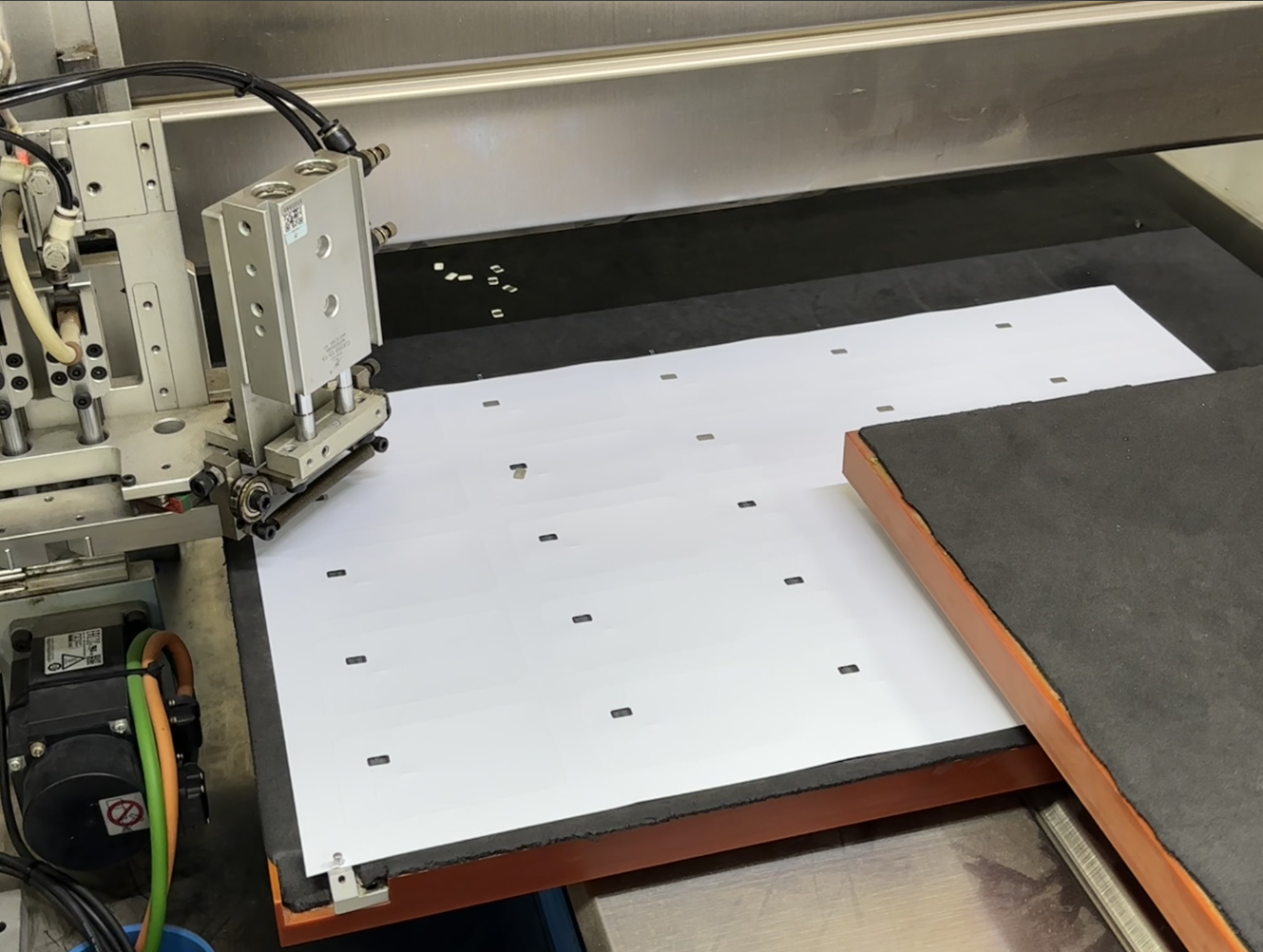
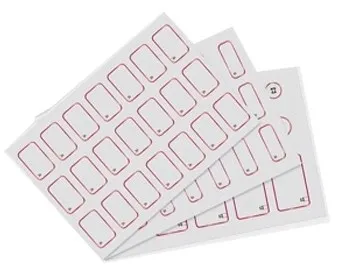
A Polycarbonate Inlay, also called a PC Inlay or PC Prelam Inlay, is an internal component used in the manufacturing of smart cards and secure identification cards.
The inlay is typically constructed from polycarbonate layers and can integrate electronic components such as:
RFID chips
NFC chips
Contact chips
Antennas
Dual-interface chip modules
Other customized electronic components
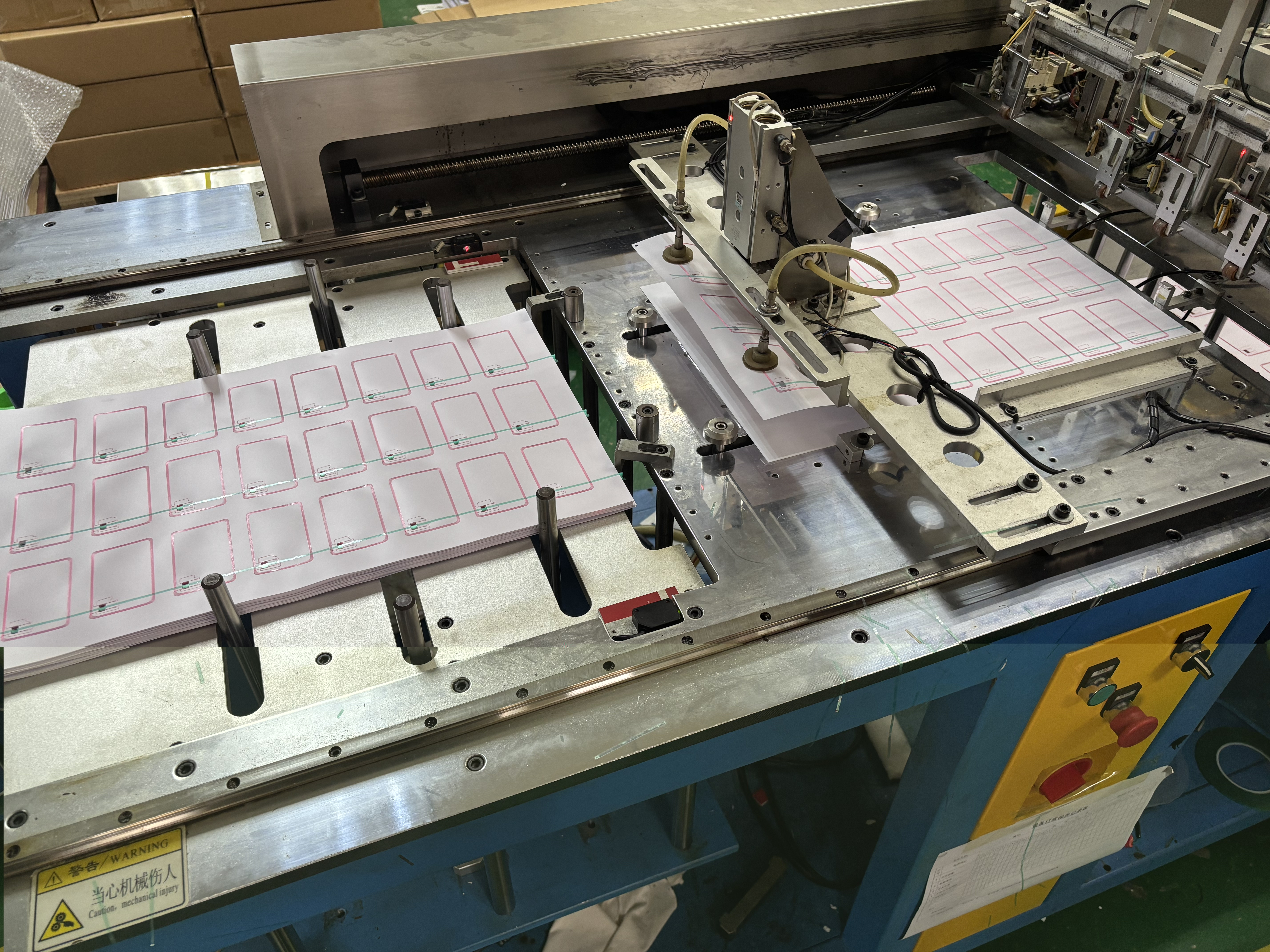
During card production, the PC inlay is integrated with additional card layers through a controlled lamination process to create the final card structure.
XINHEBAO's Polycarbonate Inlay is designed for professional card manufacturers and can be customized according to chip type, antenna structure, thickness, dimensions, layout, and final card construction requirements.
Why Is Polycarbonate Used for High-Security Cards?
The material used for a secure card is more than a structural choice. It can directly affect the card's durability, personalization method, and resistance to tampering.
Polycarbonate has several characteristics that make it suitable for high-security card manufacturing.
1. High Mechanical Durability
Polycarbonate provides strong resistance to bending, impact, abrasion, and everyday mechanical stress.
This is particularly important for identification cards and access cards that may be carried and used every day for many years.
For example, Singapore's Immigration & Checkpoints Authority has used polycarbonate for secure identification documents because of its durability and improved anti-forgery characteristics. The authority has also described laser-engraved personal information as an important security feature in its polycarbonate cards.
2. Excellent Laser Engraving Performance
One of the most important advantages of polycarbonate in secure card manufacturing is its compatibility with laser personalization.
Instead of simply printing personal information on the card surface, laser engraving can integrate information into the card structure.
Depending on the card design, information such as:
Cardholder name
Portrait photo
Identification number
Date of birth
Serial number
Security graphics
Other personalization data
can be laser engraved.

This technology is already used in various government identification documents. For example, European document specifications include laser engraving as a personalization technology for polycarbonate-based secure documents.
Singapore's identity-card system has also used laser-based personalization and security features on polycarbonate cards.
3. Strong Long-Term Stability
Secure identification cards are expected to remain functional for years.
Polycarbonate provides good dimensional stability and resistance to deformation, making it suitable for cards that need to maintain their physical structure and electronic functionality over long periods.
The European Union has specified polycarbonate or equivalent synthetic polymer for certain secure residence permit cards, with a required durability of at least 10 years.
For card manufacturers, this means that choosing a suitable PC inlay can help create a more stable card structure for long-term applications.
How Does a Polycarbonate Inlay Work Inside a Smart Card?
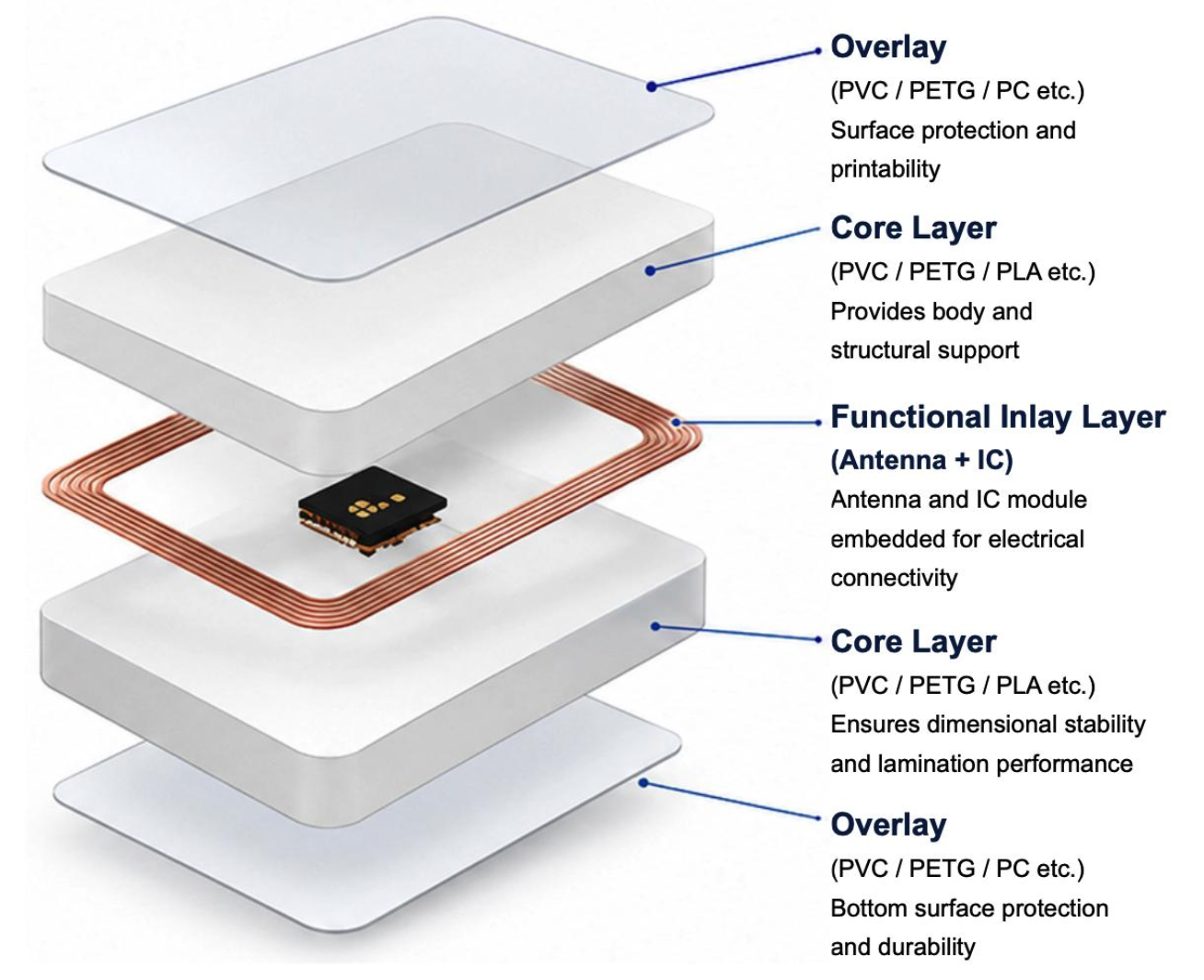
A typical secure smart card may contain multiple functional layers.
A simplified construction can include:
PC Surface Layer → Printed Layer → PC Inlay → Chip & Antenna → PC Core Layer → PC Surface Layer
The exact structure depends on the card application and manufacturing process.
The PC inlay can contain the electronic components required for contactless communication or identification.
For example:
HF RFID / NFC Card
PC Layer
↓
Printed Security Layer
↓
HF Antenna + RFID Chip
↓
PC Core
↓
PC Layer
For dual-interface cards, the structure can be customized to support both contact and contactless communication.
The position of the chip and antenna is important because the inlay must work correctly with the card's lamination structure and final personalization process.
What Chips Can Be Used in PC Inlays?
Polycarbonate inlays can be configured with different chip technologies according to the application.
For HF RFID and NFC applications, common options include:
Fudan F08
MIFARE Classic
MIFARE DESFire
MIFARE Ultralight
NTAG
ICODE
Other customer-specified 13.56 MHz chips
For LF RFID applications, possible chip options include:
TK4100
EM4200
EM4305
T5577
HITAG
For projects requiring both contact and contactless communication, customized Dual-Interface (DI) PC Inlays can also be developed.
XINHEBAO supports customized chip configurations and antenna structures according to the final card requirements.
What Is the Difference Between a PC Inlay and a PVC Inlay?
Both PC and PVC can be used in smart card manufacturing, but they are better suited to different applications.
Feature | Polycarbonate Inlay | PVC Inlay |
|---|---|---|
Material | Polycarbonate | PVC |
Durability | Excellent | Good |
Impact Resistance | High | Moderate |
Laser Personalization | Excellent | More limited |
Long-Term Stability | Excellent | Good |
Security Card Applications | Excellent | Good |
Customization | Flexible | Flexible |
Typical Applications | eID, ID, banking, secure cards | Membership, access, standard smart cards |
For standard membership cards, hotel cards, gift cards, and general access cards, PVC can be a practical and cost-effective option.
For government IDs, secure identification documents, financial cards, and other applications requiring high durability and secure personalization, polycarbonate is often the more appropriate material choice. XINHEBAO's own product comparison similarly positions PC Inlay toward high-security and long-life card applications.
Main Applications of Polycarbonate Inlay
Government ID Cards
Government identification is one of the most important applications for polycarbonate card technology.
PC inlays can be used in:
National ID cards
Electronic ID cards
Government identification cards
Secure employee ID cards
Driver's licenses
Other secure credentials
The use of polycarbonate together with laser personalization and additional security features can provide a robust card structure.
Banking and Financial Cards
Financial cards require reliable electronic functionality and strong physical durability.
PC inlays can be customized with contact, contactless, or dual-interface technologies according to the card's requirements.
Transportation Cards
Transportation cards are frequently inserted, tapped, scanned, and handled.
A durable card construction can help improve long-term performance in transportation and ticketing environments.
Access Control Cards
PC inlays can also be used for secure access-control applications, including:
Corporate access cards
Campus access cards
Government facility access
Hotel access cards
Secure entry systems
The chip and antenna configuration can be selected according to the access-control system.
RFID and NFC Smart Cards
For RFID and NFC card projects, the PC inlay can integrate the required chip and antenna while maintaining compatibility with the overall card construction.
This makes PC inlays suitable for customized smart cards that require both electronic functionality and enhanced physical durability.
Why Is Laser Engraving Important for Secure Cards?
Laser engraving is not simply a printing method.
It can become part of the card's security architecture.
When personal information is laser engraved into the card structure, attempts to remove or replace the information can leave visible evidence of tampering.
Singapore's ICA, for example, has described laser-engraved personal information and multiple laser images as security features designed to make tampering and forgery more difficult.
Other secure identification documents also combine laser engraving with UV features, optically variable elements, tactile effects, and other security technologies.
Therefore, when designing a high-security smart card, the choice of inlay material should be considered together with the personalization and security system.
Polycarbonate Inlay and Electronic Security
Physical security is only one part of a modern smart card.
For cards containing electronic chips, the electronic component can provide an additional layer of authentication.
For example, ICAO explains that electronic document authentication can verify whether an electronic document was issued by an authorized authority and whether the stored information has been altered. Additional chip-authentication mechanisms can also help address cloning risks.
This means that modern secure cards can combine several security layers:
Durable Material + Secure Lamination + Laser Personalization + Optical Security Features + RFID/NFC Chip + Electronic Authentication
The PC inlay forms an important part of this overall card structure.
What Should Card Manufacturers Consider When Choosing a PC Inlay?
Before ordering a Polycarbonate Inlay, card manufacturers should consider several technical parameters.
1. Card Application
First determine whether the card will be used for:
Government ID
eID
Banking
Transportation
Access control
RFID
NFC
Employee identification
Different applications may require different chip and material configurations.
2. Chip Type
The required chip determines the electronic architecture of the inlay.
For example, an HF 13.56 MHz card requires a different configuration from a 125 kHz LF RFID card.
3. Antenna Design
Antenna size, shape, material, and positioning can affect contactless performance.
The antenna should therefore be designed together with the chip and final card construction.
4. Inlay Thickness
The inlay thickness must match the overall card construction and lamination process.
XINHEBAO currently offers PC inlay structures with a typical thickness range of 0.40–0.80 mm or customized thickness, depending on the project.
5. Lamination Process
The inlay must be compatible with the card manufacturer's lamination parameters.
Material compatibility, thickness tolerance, layer alignment, and bonding performance should all be evaluated before mass production.
6. Personalization Method
If the finished card requires laser engraving, the PC material and inlay structure should be selected specifically for laser personalization.
This is especially important for secure ID and government-document applications.
XINHEBAO Polycarbonate Inlay for Smart Card Manufacturing
XINHEBAO provides customized Polycarbonate Inlay / PC Prelam Inlay solutions for professional smart card manufacturers.
Our PC Inlays are designed to support applications requiring:
High durability
Stable dimensional performance
Reliable chip integration
Laser personalization
Stable lamination
Customized antenna structures
Contact and contactless technologies
Dual-interface configurations
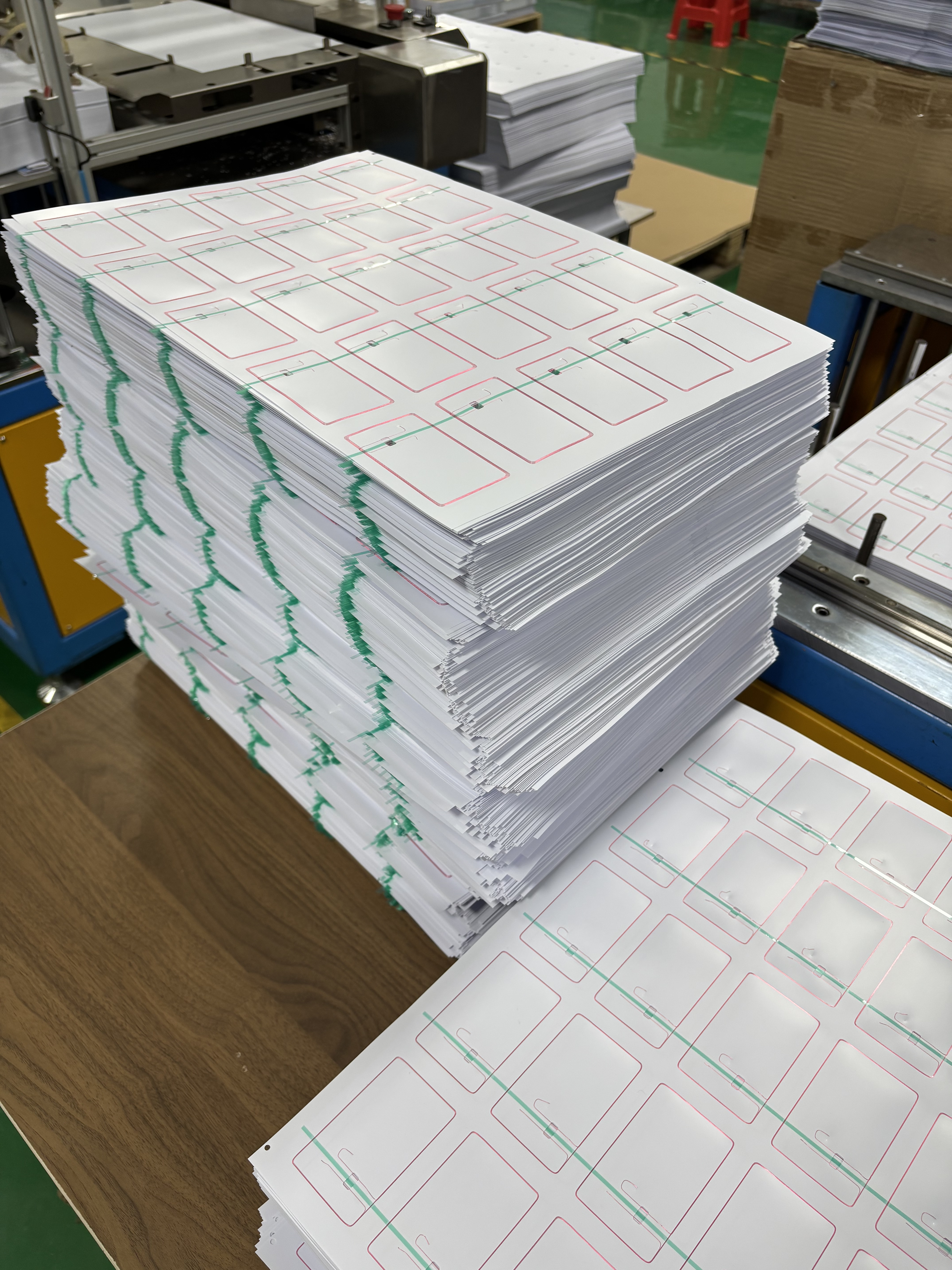
Available customization options include chip type, antenna design, chip positioning, thickness, dimensions, inlay layout, card structure, and OEM packaging.
Quality control can include material inspection, thickness control, dimensional inspection, chip-position inspection, antenna integrity testing, electrical performance testing, layer alignment inspection, lamination testing, and finished-inlay inspection.
For card manufacturers developing secure ID cards, RFID cards, NFC cards, banking cards, or other high-performance smart cards, selecting the correct inlay structure at the beginning of the project can help improve both production stability and final card performance.
Conclusion
Polycarbonate Inlay is more than an electronic component carrier. It is an important part of the overall construction of a high-security smart card.
Its combination of durability, dimensional stability, laser personalization compatibility, chip integration, and lamination performance makes it particularly suitable for applications such as government ID cards, eID documents, driver's licenses, banking cards, transportation cards, access control cards, and secure RFID cards.
As smart card technology continues to develop, card manufacturers need to consider not only the chip itself but also the interaction between the material, inlay, antenna, personalization process, and final card structure.
For projects requiring a customized PC Inlay, working with an experienced card-material manufacturer can help ensure that the inlay is matched to the required chip, antenna, thickness, lamination process, and personalization technology.
XINHEBAO provides customized Polycarbonate Inlay solutions for smart card manufacturers worldwide.