


PETG Inlay for Smart Cards: Benefits, Applications & Manufacturing


PETG Inlay for Smart Cards: Material Benefits, Applications and Manufacturing Guide
As smart cards continue to evolve toward higher durability, better material performance, and more advanced contactless functions, the choice of card substrate has become increasingly important.
For card manufacturers, the inlay is more than just an internal layer. It can affect lamination quality, dimensional stability, card durability, chip integration, and the overall consistency of finished smart cards.
PETG Inlay has become an important material option for manufacturers looking for a stable and durable substrate for modern smart card production. With good bonding performance, dimensional stability, and compatibility with different card manufacturing processes, PETG inlays can be used for RFID cards, NFC cards, ID cards, access control cards, membership cards, and other smart card products.
This article explains the role of PETG inlays in smart card manufacturing, their key material benefits, common applications, production considerations, and how to select the right PETG inlay for your project.
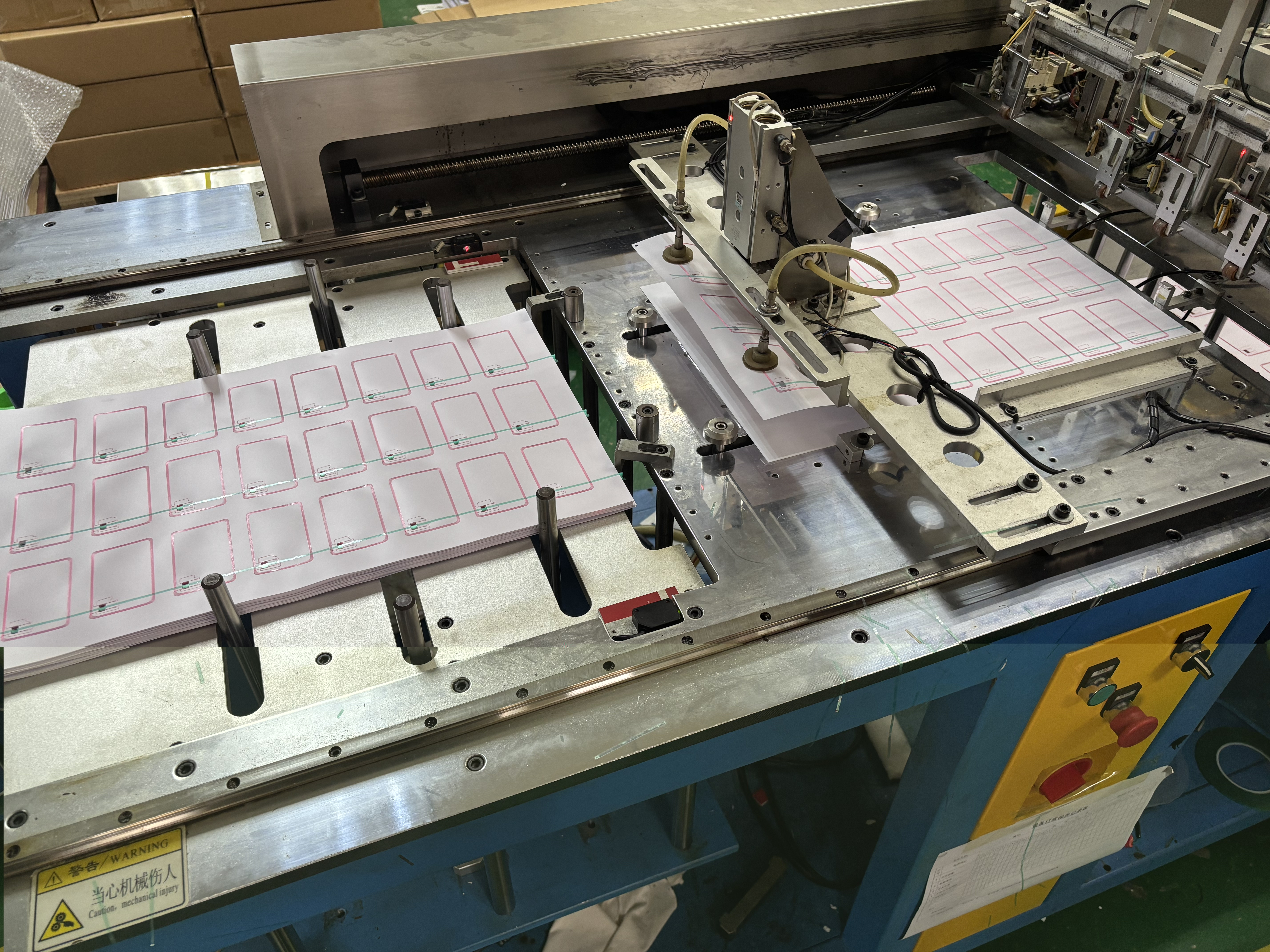
What Is a PETG Inlay?
A PETG Inlay is an internal card material made from PETG (Polyethylene Terephthalate Glycol-modified) and used as part of a laminated smart card structure.
Depending on the card design, a PETG inlay can work together with RFID or NFC chips, antennas, printed layers, core sheets, and overlay films.
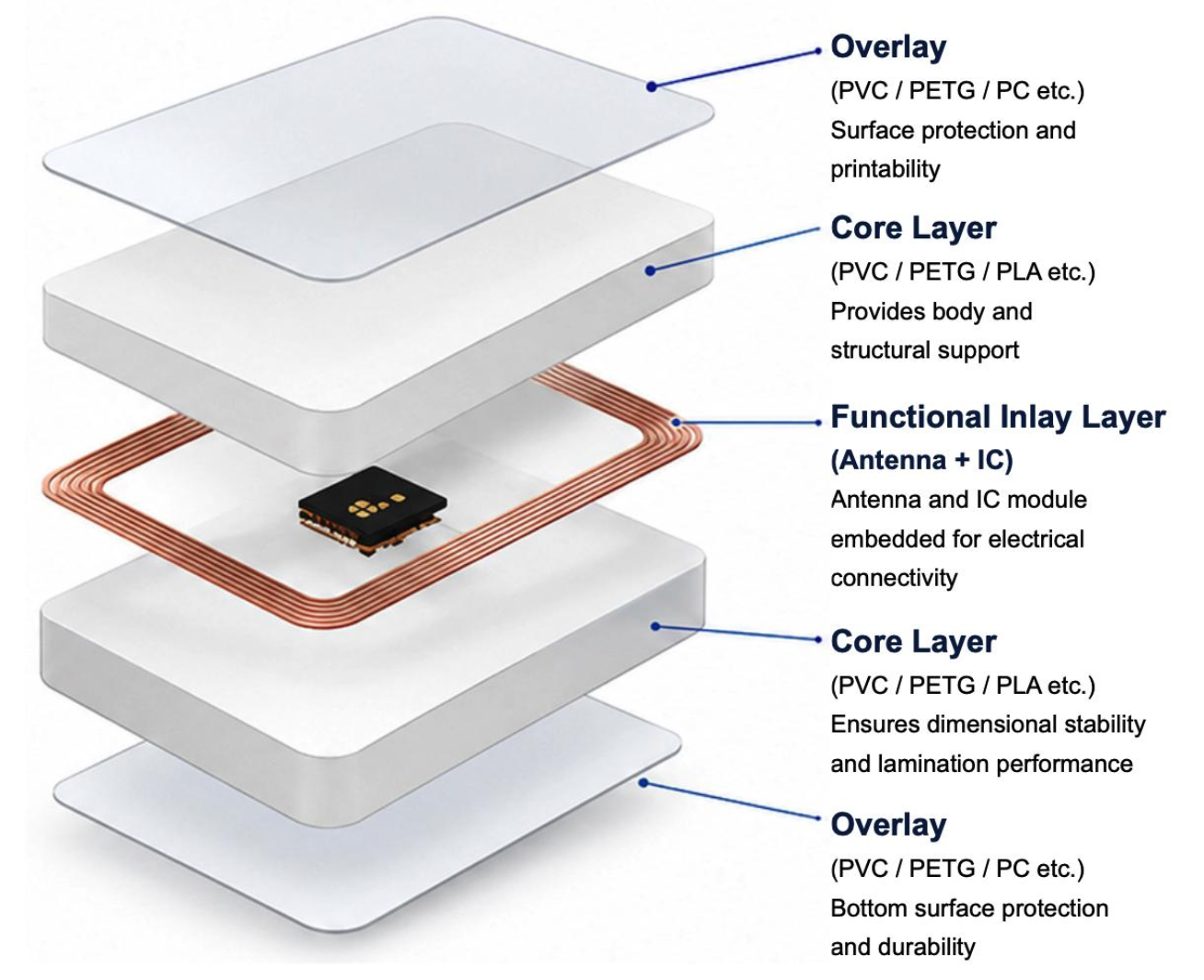
A typical smart card structure may include:
Overlay + Printed Layer + PETG Inlay + Card Core + Overlay
For contactless cards, the PETG inlay structure can also integrate an antenna and chip according to the required RFID technology.
The final configuration depends on the card application, chip type, antenna design, card thickness, and manufacturing process.
XINHEBAO's PETG Inlay is available in standard and customized formats, including A3, A4, and customized sheet sizes, with thickness options from approximately 0.06mm to 0.50mm depending on the required structure.
Why Is PETG Used in Smart Card Manufacturing?
Material selection is an important part of smart card manufacturing because the internal card layers need to withstand printing, lamination, cutting, personalization, and everyday use.
PETG offers a combination of properties that can make it suitable for modern card production.
1. Excellent Lamination Compatibility
Lamination is one of the most important stages in plastic card manufacturing.
Multiple card layers need to be bonded under controlled temperature and pressure. Poor bonding can result in problems such as delamination, bubbles, warping, or uneven card surfaces.
PETG inlays are designed to provide reliable bonding with compatible card materials during the lamination process.
This makes them suitable for manufacturers that require stable internal card structures and consistent production results.
2. Good Dimensional Stability
During card manufacturing, materials are exposed to heat, pressure, and mechanical processing.
A stable inlay material can help maintain consistent thickness, flatness, and positioning throughout the manufacturing process.
PETG inlays are designed to provide dimensional stability during lamination and subsequent card processing, helping manufacturers maintain more consistent card structures.
3. Strong Layer Bonding
The bonding between different card layers directly affects the durability of the finished product.
PETG can provide strong layer adhesion when properly matched with the surrounding card materials and lamination process.
This is particularly useful for cards designed for frequent handling and long-term use.
4. Smooth Surface
A smooth and uniform surface is important when the inlay is integrated into a laminated card structure.
PETG inlays can support different card manufacturing and printing processes, including offset printing, UV printing, screen printing, and digital printing, depending on the complete card construction.
5. Suitable for Smart Card Applications
PETG can be used as a substrate for different RFID and NFC card structures.
Depending on the project, PETG inlays can be configured for:
HF 13.56MHz RFID
UHF RFID
NFC
Dual-interface smart cards
Other customized smart card structures

PETG Inlay vs. PVC Inlay: What Is the Difference?
PVC remains one of the most widely used materials for plastic card manufacturing because of its established processing methods and cost advantages.
PETG provides another material option for manufacturers with different performance and material requirements.
PVC Inlay
PVC is commonly selected for:
High-volume card production
Standard RFID cards
Employee ID cards
Membership cards
Hotel cards
Access control cards
General-purpose plastic cards
PVC offers good processability and compatibility with conventional card manufacturing processes.
PETG Inlay
PETG can be considered when manufacturers place greater emphasis on:
Strong layer bonding
Dimensional stability
Lamination performance
Material durability
Alternative material solutions
Customized smart card structures
Therefore, the choice between PVC and PETG should be based on the final card structure, manufacturing process, required durability, material specifications, and project requirements rather than simply selecting one material for every application.
XINHEBAO currently provides both PVC and PETG inlay solutions so that card manufacturers can select materials according to their specific production requirements.
Where Are PETG Inlays Used?
PETG inlays can be incorporated into different types of smart cards and RFID-enabled products.
RFID Smart Cards
PETG inlays can be used as part of contactless RFID card structures.
Applications may include identification, access management, membership systems, transportation, and other contactless applications.
NFC Cards
PETG inlays can also be configured for NFC-enabled cards depending on the selected chip and antenna design.
Typical applications include:
NFC membership cards
NFC business cards
Contactless identification
Smart access cards
Interactive cards
Employee ID Cards
Employee cards can combine identification with access control, attendance management, and other corporate applications.
PETG inlays can provide an internal material structure for these smart card products.
Campus and Student Cards
PETG inlays can be incorporated into student cards used for identification, access control, library services, campus management, and other smart campus applications.
Access Control Cards
Access control cards require reliable communication between the embedded chip and compatible readers.
PETG inlays can be integrated into access cards for:
Offices
Residential buildings
Hotels
Schools
Industrial facilities
Security systems
Membership and Loyalty Cards
Membership and loyalty cards can use RFID or NFC technology to provide contactless identification and customer management functions.
PETG inlays can be used in:
Gym membership cards
Club cards
Hotel membership cards
Retail loyalty cards
Healthcare membership cards
VIP cards
Government and Enterprise Cards
PETG can also be considered for government and enterprise identification projects where the card structure requires stable lamination, durability, and customized material specifications.

How Does a PETG Inlay Become Part of a Smart Card?
PETG inlays are normally integrated into the card during the card manufacturing process.
A simplified production flow can be described as:
Material Preparation → Chip & Antenna Integration → Inlay Assembly → Lamination → Inspection → Cutting → Finished Card
Each stage needs to be properly controlled to achieve consistent card quality.
Step 1: Material Preparation
PETG sheets or films are prepared according to the required thickness, size, and surface specifications.
The selected material should match the final card structure and production process.
Step 2: Chip and Antenna Integration
For RFID or NFC card applications, the required chip and antenna structure are integrated according to the product design.
Chip selection and antenna design depend on the target application and reader system.
Step 3: Inlay Assembly
The functional inlay structure is assembled and positioned accurately.
Proper positioning is important because the inlay needs to align correctly with the other card layers.
Step 4: Lamination
The inlay is combined with other card materials through controlled lamination.
Temperature, pressure, time, and material compatibility all need to be considered.
Step 5: Quality Inspection
Finished PETG inlays are inspected for key parameters such as:
Thickness
Flatness
Surface quality
Dimensional accuracy
Bonding performance
Appearance
For RFID products, additional functional testing can also be performed according to the project requirements.
Step 6: Cutting and Packaging
After inspection, the material can be supplied in standard or customized sheet sizes and packaged according to customer requirements.
Key Factors When Choosing a PETG Inlay
Different smart card projects can require different material configurations.
Before placing an order, card manufacturers should consider several important parameters.
Material Thickness
The thickness of the PETG inlay needs to match the final card structure.
Common thickness options can vary depending on the application and card construction. XINHEBAO provides customized PETG thickness options within its available production range.
Sheet Size
PETG inlays can be supplied in standard sheet formats such as A3 and A4, or customized according to the customer's production equipment and card layout.
Surface Finish
Different surface finishes can be selected according to the manufacturing requirements.
Available options may include:
Glossy
Matte
Frosted
Chip Compatibility
For smart card applications, chip compatibility should be considered together with the antenna and reader system.
Depending on the project, PETG inlays can support LF, HF, UHF, NFC, and dual-interface configurations.
Antenna Type
Different projects can require different antenna structures.
Depending on the product design, copper or aluminum antenna solutions may be available.
Card Manufacturing Process
The PETG inlay should be compatible with the customer's:
Printing process
Lamination equipment
Card thickness
Cutting process
Personalization process
Final card structure
A material that works well in one card structure may require adjustment when used in another.
How Can PETG Inlay Improve Smart Card Production?
For card manufacturers, material consistency is closely related to production efficiency.
A properly selected PETG inlay can help support:
Consistent Card Thickness
Stable material thickness helps manufacturers maintain more consistent finished card dimensions.
Reliable Lamination
Good bonding performance can help reduce common lamination problems such as separation and surface defects.
Stable Card Structure
Dimensional stability helps maintain the position of internal layers during production.
Better Production Consistency
Consistent raw materials and controlled manufacturing processes can contribute to more uniform results across larger production batches.
This is particularly important for card manufacturers handling OEM projects and high-volume orders.
PETG Inlay Customization Options
Smart card projects often have different requirements, so standard specifications may not always be sufficient.
XINHEBAO provides customization options for PETG inlay projects, including:
Custom thickness
Custom sheet size
Custom layout
Different surface finishes
Different chip compatibility
Different antenna configurations
Customized packaging
Customers can provide their card specifications and production requirements so the inlay structure can be matched to the intended application.

Why Choose XINHEBAO for PETG Inlay?
XINHEBAO specializes in card base materials and smart card products, providing PVC, PETG, polycarbonate, and other card material solutions.
For PETG inlay projects, XINHEBAO provides:
Professional Manufacturing Experience
XINHEBAO has more than 15 years of experience in card base materials and customized card products.
Flexible Customization
PETG inlay specifications can be customized according to thickness, size, surface, chip, antenna, and card structure requirements.
Quality Control
Production inspection focuses on important parameters such as thickness, surface quality, flatness, bonding, and overall production consistency.
Sample Support
Samples can be provided before bulk production so customers can evaluate the material and test it within their own card manufacturing process.
Stable Supply
Standard and customized PETG inlay solutions are available for different order quantities and smart card projects.
How to Order PETG Inlay for Your Smart Card Project
To receive a suitable PETG inlay recommendation, card manufacturers can provide the following information:
Intended card application
Card size
Required inlay size
Inlay thickness
RFID/NFC chip type
Antenna requirements
Surface finish
Card construction
Estimated order quantity
With these specifications, the PETG inlay can be developed or selected according to the actual production requirements.
For new projects, requesting samples before mass production can also help verify compatibility with the customer's lamination equipment and card structure.
XINHEBAO PETG Inlay for Smart Card Manufacturing
XINHEBAO PETG Inlay is designed for card manufacturers and smart card solution providers looking for a stable material for modern card production.
With good lamination compatibility, dimensional stability, smooth surface quality, and customizable specifications, PETG inlays can be used for RFID cards, NFC cards, ID cards, access control cards, membership cards, campus cards, and other smart card products.
Available specifications include:
Material: PETG
Color: White / Transparent
Thickness: 0.06–0.50mm, customized
Size: A3 / A4 / Customized
Surface: Glossy / Matte / Frosted
Chip Compatibility: LF / HF / UHF / NFC
Antenna: Copper / Aluminum
Application: RFID Card / NFC Card / Smart Card Production
These specifications can be adjusted according to the requirements of the final card structure.
Conclusion
PETG Inlay is an important material option for manufacturers producing modern RFID, NFC, identification, access control, membership, and other smart cards.
Its combination of lamination compatibility, dimensional stability, bonding performance, smooth surface quality, and customization flexibility makes it suitable for a wide range of card manufacturing applications.
However, choosing the right PETG inlay requires more than simply selecting a material. Thickness, sheet size, surface finish, chip technology, antenna structure, lamination conditions, and final card construction should all be considered together.
For card manufacturers looking for customized PETG inlay solutions, XINHEBAO provides different material specifications and customization options to support both sample testing and bulk production.
Looking for PETG Inlay for your smart card project? Contact XINHEBAO with your required thickness, sheet size, chip type, application, and order quantity to discuss a customized solution.

